Stem Cell Therapies in Germany: What Is Legal vs What Is Not
Stem cell therapies are developing rapidly, but they are still at the cutting edge of aesthetic and regenerative medicine. That’s why the legislatio…




Burnout used to be framed mostly as an employee problem. The data now says otherwise: the people running organizations are burning out at least as often as the people working for them. In fact, in 2025, 56% of C-suite executives reported experiencing burnout, up from 52% the year before, according to a global survey of more than 2,600 leaders across ten countries.
As with all burnout, executive burnout is different from ordinary tiredness. It has specific symptoms and a recovery process that involves far more than a few good nights of sleep.
This guide breaks down what executive burnout is, why leadership makes you more exposed to it than most roles, what it does to your body, and what real recovery requires.
Burnout isn’t classified as a disease by the World Health Organization, nor does it appear as a diagnosis in the DSM-5. Yet psychologists widely agree it’s a distinct condition, marked by a recognizable set of symptoms.
Clinicians rely on three main signs to recognize burnout:
While one or two of these symptoms can be a sign of overwork or difficult working conditions, people who present with all three are considered to suffer from burnout.
It can be difficult to distinguish burnout from everyday stress or from clinical depression. Both can result in reduced productivity and tiredness, as well as increased cynicism.
Everyday stress is tied to specific events or projects, and so it rises and falls according to real-life factors: a hard quarter, a big launch, a board meeting. It’s unpleasant, but it resolves once the pressure lifts. With burnout, however, it often feels like the stress never abates, no matter what happens.
Depression touches how you feel across every part of your life, not only your job, and it requires its own diagnosis and treatment path, often including medication.

When you’re in a position of leadership, you face unique stressors and pressure linked to the responsibility you hold. This makes burnout more likely, as well as more inconvenient.
Every decision you make draws from a limited reserve of mental energy.
As an executive, you make decisions all the time, from small organisational choices to huge strategic decisions, and this is extremely draining. Most of your choices are impossible to avoid, and they have real consequences, which further increases how much of your energy they require.
Leaders also have no real off switch.
Even when nothing is on fire, knowing that something could be keeps part of your attention pinned to work, so you never fully rest. And leadership is a lonely place to feel that. Venting to your team reads as a lack of confidence, so more often than not, executives have to carry the strain alone.
There’s an assumption that burnout only happens to people who hate their jobs. The opposite is closer to the truth.
The executives who burn out hardest are usually the ones who care most, and struggle to stop putting long hours into their passion project. If the work matters, saying no feels like letting people down, and resting feels like lacking commitment. That’s why burnout so often lands on the people who look, from the outside, like they’re thriving.
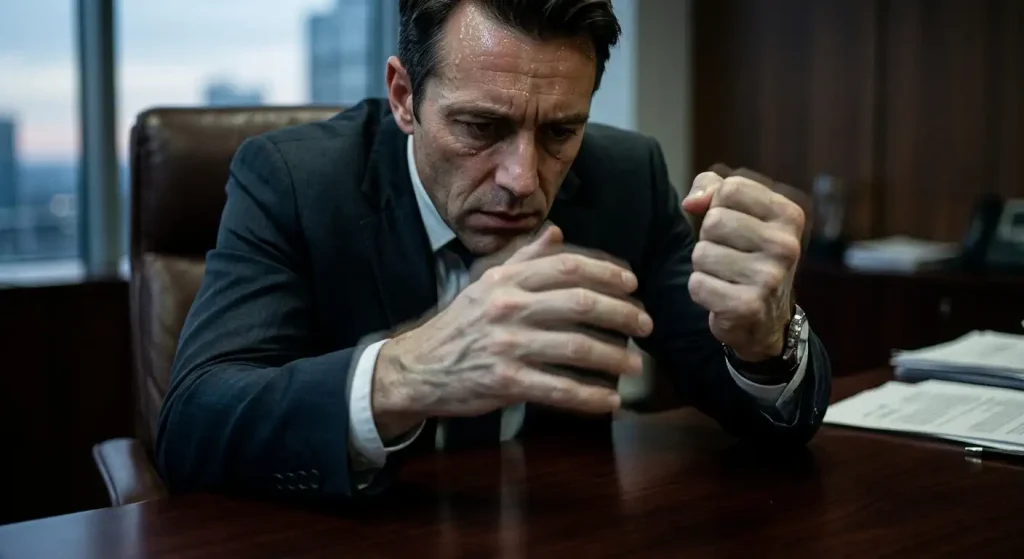
Beyond the mental symptoms of burnout, it leaves proven marks on the body. By the time most executives acknowledge what’s happening, those changes are already underway.
Cortisol, our stress hormone, is designed to spike in reaction to short-term dangers and then settle back down once the threat passes.
When we face chronic, unrelenting stress, the system never gets time to recover. The cost of holding it switched on accumulates across the body, and starts to show in immune function, cardiovascular strain, and metabolic regulation.
Burnout and poor sleep feed each other, and the loop is hard to break. Elevated stress hormones make it harder to fall asleep and stay asleep, and the sleep you lose leaves you less able to handle stress the next day.
Even a few bad nights have a measurable effect on immune function. Months or years of it raise the risk of serious illness. Plenty of executives are proud of sleeping just five hours a night, but it has a high cost in the short and longterm.
Burnout wears down the exact faculties leadership relies on.
It has been associated with deficits in attention, working memory, and executive function, all of which are necessary for making complex decisions. And it compounds: the more overloaded you get, the worse your judgment becomes, and the less equipped you are to notice it slipping.
Burnout builds gradually, which is why it’s so often missed until it’s already severe. Knowing the early warning signs helps you catch burnout earlier.
If several of these are present at once and have lasted more than a few weeks, that’s a strong sign to treat this as more than ordinary fatigue.

Pushing through with sheer discipline is usually what got you here in the first place, and continuing to do so won’t put an end to burnout.
A long weekend or a week off can lift your mood for a few days. But research on vacation effects shows that the benefits tend to fade within days of returning to work, especially for people in high-demand roles.
Feeling calmer for a week isn’t the same as your body having recovered. It’s easy to mistake distance from your inbox for actual recovery.
A short break is not usually enough to restore your cortisol rhythm, improve your sleep, or regulate your nervous system, which is why you end up back in the same place within a few days at the office.
Real recovery has to address both the mind and the body, because burnout is both a mental and a physiological condition.
Burnout is usually linked to your workload and working conditions, and it is hard to fully recover from burnout without addressing that environment.
Therapy or executive coaching is recommended to help you process what’s happened and build boundaries. That being said, therapy and concrete changes to your work routine only address the psychological and behavioral side of the problem.
They don’t reverse the physical toll that months or years of chronic stress have already taken on your cortisol regulation, your sleep, your immune system, and your cellular repair processes.
A dysregulated stress response, disrupted sleep schedule, and depleted immune system all require physiological interventions so that they can be reset.
Many burnout recovery plans skip this step, which is a mistake, because it means your body never fully recovers. Alongside a therapist, it is necessary to consult a doctor so you can discuss targeted regenerative treatments to heal your body on a physiological level.
Switzerland is a popular destination for executives looking for a full reset, because of its high-quality clinics and serene scenery.

Switzerland attracted those looking to improve their health long before the boom of the modern wellness industry.
Towns across the Alps and around Lake Geneva built medical practices around rest cures and supervised recovery from the 19th century onward. This culture of high-quality medical care has shaped the current landscape of world-class clinics, offering cutting-edge rejuvenation and longevity treatments.
Swiss clinics are built around discretion as a matter of course, and many are accustomed to catering to public-facing executives who would rather their health not become a headline.
While your visit will pass under the public radar, it will be closely supervised by a team of qualified clinicians, who tailor every part of the program to your needs.
Many of Switzerland’s leading longevity clinics are situated around Lake Geneva, and the setting itself helps with relaxation and recovery. The lake, mountain peaks, clean air, and absence of noise help reset your nervous system and give your body a break from stressors.
A proper physiological reset addresses your body systematically, across several fronts at once, rather than relying on a single treatment to do all the work.
Most burnout programs start with a full medical workup, combined with epigenetic testing that looks at how chronic stress has actually altered the way your genes are being expressed. The rest of the program is then built around your own physiological reality and specific requirements.
Nutrition during the program is adjusted to what your body is depleted in after months or years of stress. Chronic stress burns through specific nutrients and disrupts digestion in specific ways, and the best way to reverse that is a healthy diet including all the nutrients you are missing.
Structured, medically supervised fasting gives your digestive, nervous, and immune systems a break from constant processing. Fasting is also linked to increased autophagy, the process by which cells clear out and recycle damaged components, and which massively contributes to your overall health.
Targeted cell therapy and revitalization treatments support your body’s own repair mechanisms, fixing the physiological consequences of chronic stress rather than waiting for your body to catch up.
For executives looking for a deeper reset, regenerative options, including stem cell treatments, can be added to support tissue repair. Rather than directly addressing burnout, these should be seen as a longer-term investment in overall physiological resilience.

Recovery isn’t instant, and being wary of anyone who promises otherwise is reasonable. That said, the trajectory of a well-designed program is fairly predictable.
Most executives leave with measurably better sleep, a calmer physiological baseline, and real mental clarity, changes you can typically feel within days. Once your exhaustion starts to lift, you will notice that your nervous system has had a chance to properly downshift for the first time in a long while.
The deeper physiological changes, cortisol regulation, immune resilience, and energy levels continue to improve for weeks after you’re home, provided the habits and structure from the program are maintained.
Executive burnout is a condition that affects both the body and the mind, and pushing through or taking a weekend off cannot fix it. For lasting recovery, you need a mixture of psychological and medical support.
Clinique Lemana, situated near Lake Geneva in Switzerland, offers specialized programs for executive burnout, so you can get your health back on track.
Get in touch with our team to plan a recovery stay that fits your needs.
If a few days off genuinely restores you and the feeling holds once you’re back at work, that’s ordinary fatigue. If you feel just as depleted, cynical, or foggy a week or two after returning, that points to burnout rather than simple tiredness, and it’s worth seeking a proper evaluation.
Yes. With the right combination of psychological support and physiological recovery, the exhaustion, cynicism, and cognitive effects of burnout can genuinely improve. It takes more than rest alone, though, since the underlying physiological dysregulation needs to be actively addressed rather than simply waited out.
Many people notice real change within one to two weeks of an intensive, medically supervised program, with further physiological improvements, cortisol regulation, immune function, sustained energy, continuing for weeks afterward.
Swiss clinics offer specialized burnout recovery programs, as well as high standards of care and discretion, that are almost unmatched anywhere in the world.
For a meaningful reset, yes, at least temporarily. Your body needs uninterrupted downtime to recover, and this is very difficult to achieve while still checking email or taking calls between sessions.
Generally, no. These programs are typically considered elective and are paid for privately, though coverage varies by provider, policy, and country, so it’s worth checking directly with your insurer before assuming either way.