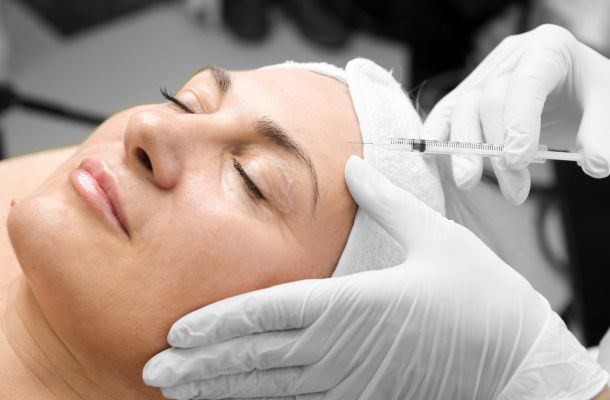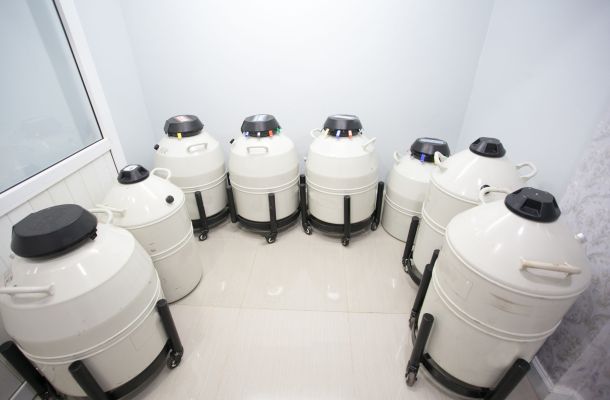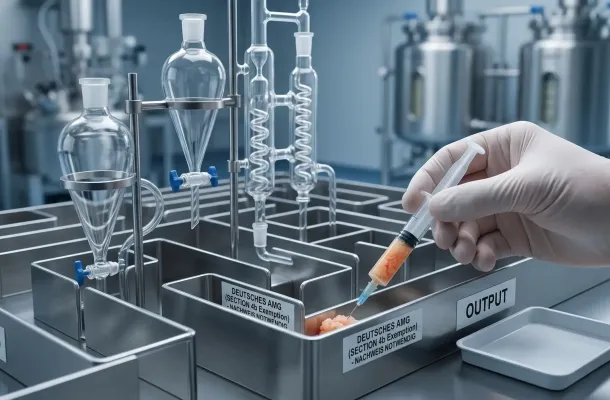
Stem Cell Therapies in Germany: What Is Legal vs What Is Not
Stem cell therapies are developing rapidly, but they are still at the cutting edge of aesthetic and regenerative medicine. That’s why the legislatio…



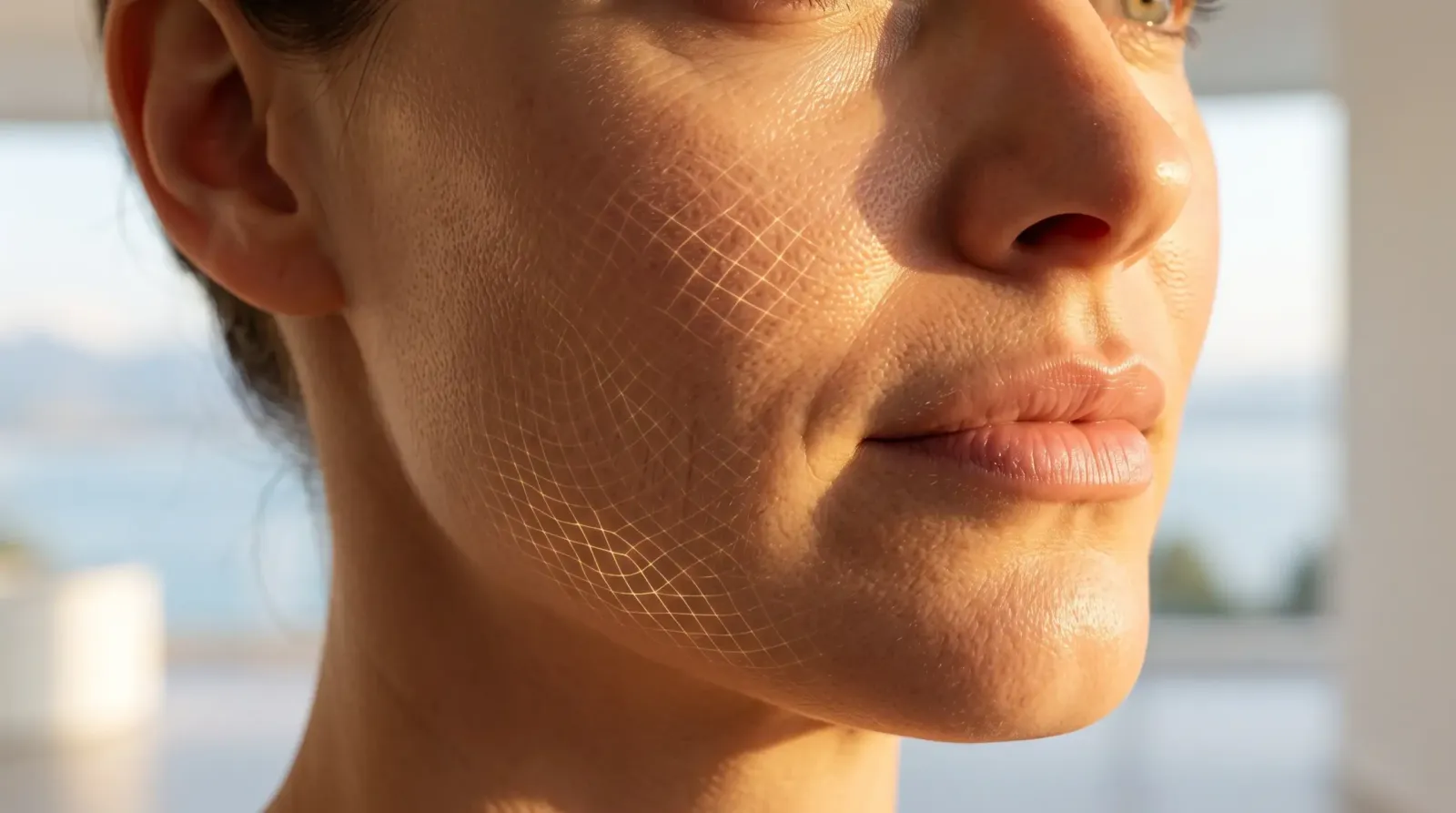
Many fillers are marketed as stimulating collagen, that all-important protein that keeps the skin firm. Unfortunately, not all of them have the evidence to back up the marketing claims. While select types of filler have been shown to boost new collagen production, most have a mild effect at best that is incidental to their primary mechanism of adding volume.
This guide walks through exactly which fillers stand up to scrutiny and what their limits are, before introducing the regenerative treatments that go further still towards boosting collagen levels. It will help you understand what you can expect from a treatment, and whether it is the right way to reach your goal.
Collagen is the protein that gives skin its structure. It is what keeps skin firm, resilient, and able to bounce back after you smile, sleep on your side, or lose a little weight. The trouble is that this scaffolding does not renew itself indefinitely. Collagen production slows from our mid-twenties onward, and the decline accelerates with sun exposure and, for women, after menopause.
This is why “collagen stimulating” has become a buzzword in aesthetic medicine. If a treatment can encourage the skin to produce more of its own collagen, rather than simply adding volume, the results tend to look more natural and last considerably longer.

Before comparing individual products, let’s take a look at what “collagen stimulation” actually means at a biological level.
In truth, almost any foreign material injected beneath the surface of the skin will provoke some kind of response. Down at the level where collagen is made, the body keeps immune cells and fibroblasts close at hand, and they react to anything they read as new tissue.
That happens with more or less every filler on the market, by design or not. Still, a brief reaction to a gel is different from a sustained process that rebuilds tissue quality.
Most fillers work one of two ways: either by taking up space themselves or by building new tissue to create volume.
A common example of the first kind is hyaluronic acid gel, which acts somewhat like a sponge, holding onto water and plumping up tissue from within. This softens lines on the skin and restores volume to the cheeks. Any collagen response this triggers is a mild side effect of the gel being present, not its primary mode of action.
Other fillers are designed to disappear over time while leaving new collagen behind. These are called biostimulators. Their particles are broken down gradually by the body, and it is this breakdown process, along with the body’s response to the particles themselves, that stimulates fibroblasts to produce new collagen. The volume you see with biostimulators isn’t the injected product itself, but cells created as it breaks down.
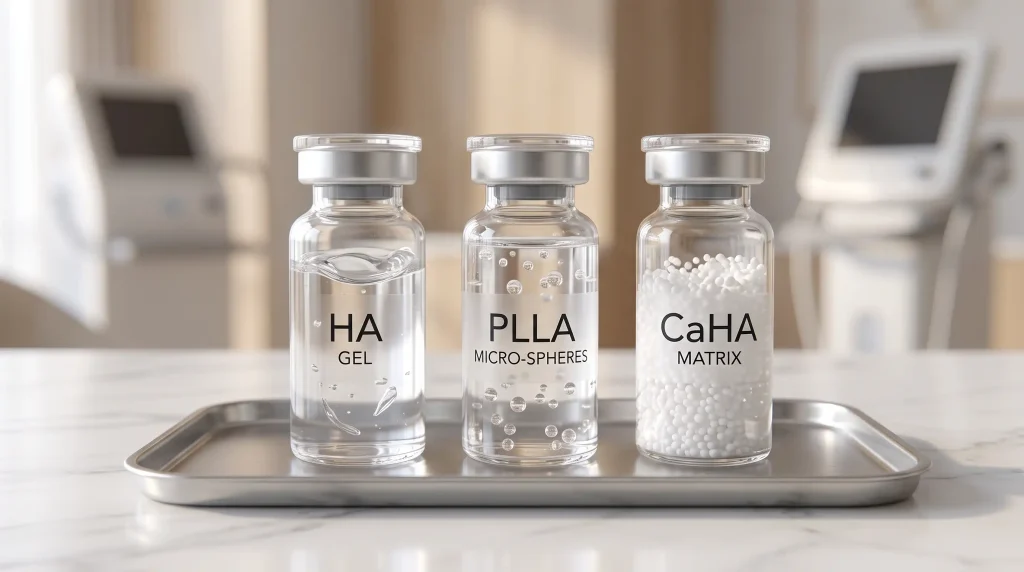
With that distinction in mind, here is how the main categories of injectable fillers work, and how they impact collagen production.
Poly-L-lactic acid, or PLLA, is the best studied of the true biostimulators and the closest thing to a gold standard collagen-stimulating filler.
It comes as tiny particles suspended in liquid. Once injected, those particles set off an inflammatory response. Fibroblasts and immune cells called macrophages gather around them, and as the particles break down over the following weeks, they release signals that switch on new collagen production. The collagen this builds can last two years or more, longer than the filler itself stays in the tissue.
Calcium hydroxylapatite, or CaHA, works through a dual mechanism, making it something of a mix of hyaluronic acid and PLLA. Tiny balls of calcium (calcium hydroxylapatite microspheres) are suspended in a gel carrier. The gel gives immediate volume on the day of treatment, much as a hyaluronic acid filler would. The microspheres behave like biostimulators. As they break down over the following months, they prompt fibroblasts to produce new collagen. Results typically last up to eighteen months.
Polycaprolactone, or PCL, is a newer biostimulator that follows the same dual-mechanism logic as calcium hydroxylapatite, but with even longer effects. Because the PCL microspheres degrade very gradually, they boost fibroblast activity and new collagen formation for over two years.
Hyaluronic acid fillers are the most widely used injectable fillers in the world. They add volume immediately, and they can be dissolved with an enzyme if anything needs adjusting. Their relationship to collagen is secondary, and it holds only as long as the gel does. Once the HA is metabolized, usually within six to eighteen months, the collagen stimulation goes with it.
| Filler type | How it works | When results show | Typical duration | Collagen stimulation strength |
| Hyaluronic acid (Juvederm, Restylane) | Volume from water binding gel, mild secondary fibroblast stretch | Immediate | 6 to 18 months | Mild, secondary effect |
| Poly-L-lactic acid (Sculptra) | Microparticles trigger fibroblast and macrophage activity | Gradual, over 4 to 8 weeks per session | Up to 2 years or more | Strong, primary mechanism |
| Calcium hydroxylapatite (Radiesse) | Gel gives instant volume, microspheres stimulate collagen as they break down | Immediate plus gradual | Up to 18 months | Strong, dual mechanism |
| Polycaprolactone (Ellanse) | Microspheres stimulate collagen over an extended breakdown period | Immediate plus gradual | 1 to 4 years | Strong, longest duration |
Even the strongest biostimulating fillers, PLLA, calcium hydroxylapatite, and polycaprolactone, have limits when it comes to stimulating collagen.
A biostimulator filler pushes your fibroblasts into a burst of activity around the particles.
But it doesn’t address the causes of diminished collagen production, such as accumulated UV damage, slower cellular turnover, and the hormonal shifts that come with age. Once the particles have broken down, the local effect is gone too, and your skin’s capacity to produce collagen is back where it started.
By design, every filler discussed here, including the biostimulators, is resorbable. That is what makes them safe to be injected, but it also naturally limits the duration of the collagen boost. It can slightly outlive the product itself, but results do plateau, then gradually fade.

There is also an aesthetic risk to using fillers, especially repeated treatments. Excess volume can look unnatural and produce a rounded, overfilled look that has become known as “pillow face”.
Since the volumizing effect of biostimulators is delayed, it is possible to over-treat without realising it until weeks or months later.
Biostimulator fillers are reliable and give good, natural-looking results. But if you’re trying to improve the health and appearance of your skin over the long term, rather than just restoring volume for a year or two, fillers are not the right treatment, even the ones that genuinely stimulate collagen.

This is where regenerative treatments shine. They can improve facial structure and volume, but also work at a deeper level.
Regenerative treatments are not technically fillers, but cell-based therapies that help the skin repair itself. Here are some of the main differences:
Within regenerative medicine, two approaches currently stand out when it comes to long-term collagen stimulation.
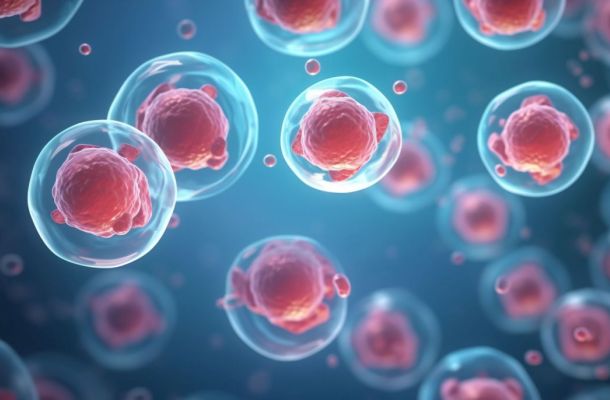
Adipose-derived stem cells, harvested from a small amount of your own fat tissue, are among the most extensively researched regenerative options for the skin. These cells can be introduced directly into the skin, where they boost collagen production and help restore the skin’s regenerative capacity and its structure.
Because the treatment uses living, biologically active cells rather than a resorbable particle, its effects tend to build gradually and last for years after a single treatment.
Exosomes and platelet-rich plasma, or PRP, both work by stimulating the body’s signalling mechanisms. PRP is prepared from a small sample of your own blood, concentrated to isolate the platelets, which release growth factors known to switch on collagen production.
Exosomes, meanwhile, are tiny signalling particles that carry messages. When injected into the skin, they instruct nearby fibroblasts to become more active and produce collagen.
| Treatment | Pros | Cons | Look and detectability |
| Biostimulator fillers (Sculptra, Radiesse, Ellanse) | Well studied, faster to access, lower cost per session, results within weeks, minimal downtime | Effect is localized and indirect, fully resorbs over time, does not improve overall skin regenerative capacity, some granuloma risk | Natural when dosed correctly, gradual onset avoids an overfilled look, but risk of palpable nodules or lumps if diluted incorrectly |
| Hyaluronic acid fillers | Immediate volume, reversible with an enzyme, well established, lower barrier to entry | Only a mild secondary collagen effect, shortest duration of the categories covered here | Risk of pillow face and Tyndall effect (bluish tint under thin skin) if overused or placed too superficially |
| Stem cell treatment | Works at a cellular level, addresses tissue quality broadly rather than one area, results described as very natural, option to cryopreserve cells for future use | Requires fat harvesting under anesthesia, higher cost and time investment, results take longer to fully appear, fewer long-term studies than filler categories | Reads as improved skin quality rather than added volume, generally the hardest of these categories to detect |
| Exosomes and PRP | Non-surgical, complements other treatments well, supports skin quality and hair alongside collagen | Evidence base still developing compared to stem cells, typically needs to be paired with another treatment for volume, results are subtler on their own | Subtle, skin-quality-level change, very low risk of an artificial or overfilled look |

The right choice depends on what you are trying to achieve and on how much time and money you want to put into it.
A biostimulating filler such as Sculptra, Radiesse, or Ellanse makes sense if you have a specific area of volume loss you want addressed, such as hollowed cheeks or a softened jawline, and you want a well-established treatment with relatively quick results. It is also a good place to start if you are new to injectables or if you have a smaller budget.
A regenerative approach makes more sense if what you care about is the overall quality of your skin and its capacity to repair itself, rather than volume in one particular area. It also suits people who prefer treatments that work with their own biology instead of an external material, and anyone who wants to avoid looking overfilled as they age. The trade-off is a larger investment of time and money at the outset, in exchange for results reported to last considerably longer.
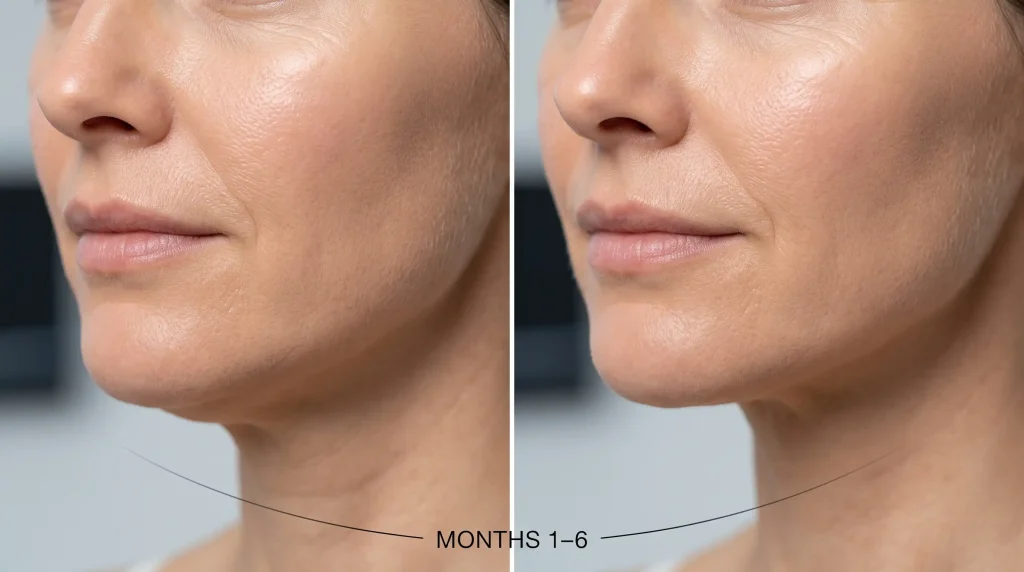
Both biostimulating and regenerative treatments work on a different timeline than standard hyaluronic acid fillers, so it is worth knowing what the weeks and months afterwards actually look like.
Hyaluronic acid fillers show their result on the day of treatment, while the effects of biostimulators build up over four to eight weeks. Regenerative treatments take longer still. Stem cell treatments reach their fullest effect over a period of months, as the cells settle in and the surrounding tissue responds, though many people notice an early improvement in skin quality well before that.
Biostimulator fillers are usually given as a short course, often two or three sessions four to six weeks apart, to build the full result, followed by a maintenance appointment roughly once a year.
Regenerative treatments are built around fewer, more concentrated sessions. A stem cell treatment may be a single procedure with effects reported to last for years. Exosome and PRP treatments are usually given as a short series and topped up periodically.
Some fillers have a mild effect on collagen levels, which can be slightly boosted for up to two years after the injection. However, if you want a lasting improvement to the quality of your skin and its ability to repair itself, regenerative treatments such as stem cells, exosomes, and PRP are the more durable path, working with your own biology rather than around it. At Clinique Lemana, we can help you weigh these options against your skin and your longer-term goals. Get in touch to discuss the right rejuvenating skin care program for you.
No. All fillers provoke some biological response once placed in the skin, but only certain categories, such as poly-L-lactic acid, calcium hydroxylapatite, and polycaprolactone, are proven to trigger meaningful new collagen production.
Poly-L-lactic acid (Sculptra) is generally regarded as the strongest collagen-stimulating filler, followed closely by calcium hydroxylapatite (Radiesse) and polycaprolactone (Ellanse).
Results of biostimulating fillers typically build over four to eight weeks following each session.
As long as they are administered by an experienced practitioner, biostimulating fillers have a well-established safety profile. As with any filler, there are risks, including palpable nodules and, uncommonly, granuloma formation.
It depends on your goal. Stem cell treatments offer more natural, longer-lasting improvements to overall skin quality, while biostimulating fillers offer a faster and more affordable option for addressing volume loss in a specific area.
Yes, and it is a common combination. A biostimulating or hyaluronic acid filler can add volume, while exosomes, PRP, or stem cells work on the quality and repair capacity of the surrounding skin. A qualified practitioner can advise on how best to combine them.
Done well, a collagen-stimulating filler is hard to detect. Results build gradually rather than appearing all at once, which reads as far more natural. The risk of looking visibly “done” comes from overuse or poor placement.