Are Stem Cell Therapies Legal in the UK?
Some stem cell therapies are fully legal in the UK. Bone marrow and cord blood transplants for blood cancers are standard NHS treatment. Experimenta…


If someone has too many rounds of facial fillers, they may end up with what is known as “pillow face”. Rather than regaining youthful volume, their skin can look inflated or swollen. Cheeks sit high and round, contours disappear, and expressions no longer move the way they should.
“Pillow face” usually comes from years of top-ups, not a single bad session. It can be linked to bad choices of either product or placement. This guide covers how to recognize it, what causes it, how to avoid it, and how it can be corrected.

Pillow face happens when your face is carrying more filler than its structure can hold. Some signs occur when your face is at rest, while others only appear when you smile or talk.
The first things that an overfilled face loses are its definition and natural movement.
Your face is designed to move. When you smile, the fullest part of your cheek rises by over a centimeter, while the deeper fat is kept in place by a thin band of connective tissue. If too much filler sits in this area, smiling pushes it up into an unnatural bulge. It’s because of these expressions that an overfilled face can look fine in a photo but odd when you’re talking to someone.
A youthful face is shapely, with a curve going from the cheekbone down into a slight hollow above the jaw, which catches shadow and gives the face definition. Loss of natural contours is a common feature of an overfilled face. When filler is added until the cheek looks full from every angle, that hollow fills in too, and the face reads as wider and flatter from the front.
Excess filler overstretches the skin, which changes its texture. It can look tight and slightly shiny, particularly over the cheeks and under the eyes, where the skin is thinnest.
Overfilling can happen anywhere filler is used, but some areas are more prone to it than others. Either the extra volume is easy to see there, or the tissue doesn’t drain fluid well.
The cheeks are where pillow face is most obvious. They move a lot when you talk and smile, so any excess filler shows quickly. Filler in the upper cheek can also get in the way of the lymphatic system, the network of tiny vessels that drains fluid from your tissues. When that happens, fluid builds up and causes a lasting puffiness over the cheekbones, known as malar edema.
The under-eye area is the most delicate of all. The skin is thin, and fluid drains slowly. Swelling follows filler around the eyes in roughly 11% of cases, and imaging suggests the filler itself can press on the small vessels that drain the area. The result is a heavy, puffy under-eye that makes you look tired and aged.
Temples are often filled to restore the frame of the face, but the filler doesn’t always stay where it was put. It has been found moving down into the cheeks, adding volume to an area that may already be full. The nasolabial folds, the lines running from your nose to the corners of your mouth, are also one of the places where filler most often moves. Filling them directly can also weigh down the lower face, without fixing the loss of volume in the cheeks.
These three are easy to confuse, but they have different causes.
Timing is the simplest test. If fullness is still there a month after treatment, or has built up over several appointments, it’s worth getting it assessed rather than waiting it out.
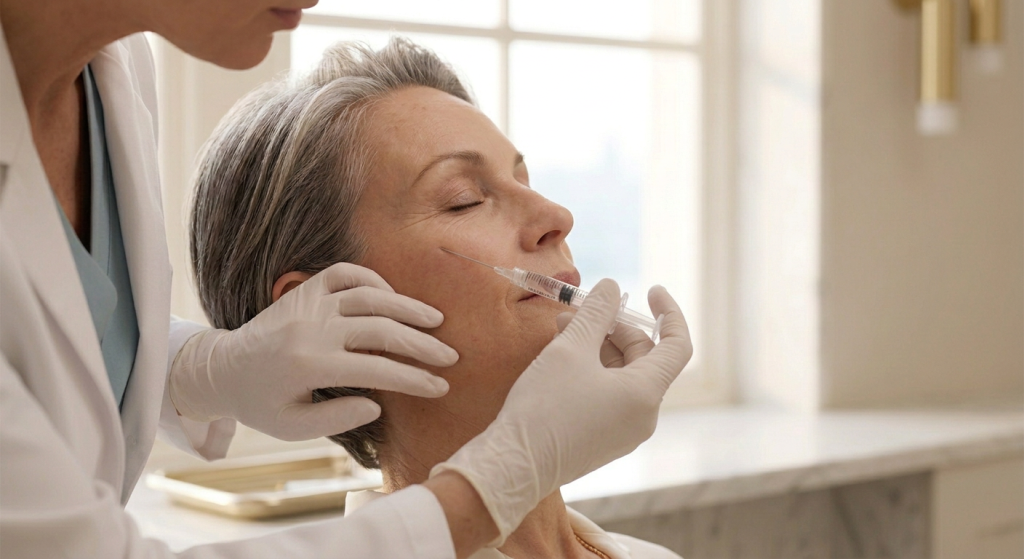
Researchers point to a mix of factors leading to pillow face, most importantly, the injector’s technique and the product used, as well as the number of sessions requested by patients.
The most obvious cause is using more filler than an area needs, or adding it faster than the tissue can adjust. Researchers have linked overfilled faces to aggressive treatments that change the face too quickly.
Trying to fix everything in one appointment is one of the easiest ways to end up overfilled. Swelling on the day makes it hard to judge how much filler is really there, and some hyaluronic acid fillers keep absorbing water after they’re injected. A result that looks right in the chair can look heavier a week later, which is why doctors advise against overfilling in a single session.
Patients can get used to a fuller face and start asking for more, and some practitioners feel commercial pressure to say yes. A good injector will sometimes suggest doing less than you asked for, and that’s usually a sign you’re in safe hands.
Your face is built in layers, from bone and deep fat up through muscle, surface fat, and skin, and each layer reacts to filler differently.
Filler placed too close to the surface is more likely to show. Around the eyes, it can create visible lumps and outlines, and filler sitting in the upper layers of the skin can give it a faint bluish tint. In the upper cheek, filler placed too close to the surface can also trap fluid, causing puffiness.
Much of facial aging starts deep down. Bone slowly changes shape, and the deeper fat pads shrink, leaving the skin above with less support. Placing small amounts of firm filler deep, close to the bone, replaces that lost support instead of padding the surface. Injection guidelines describe this deep technique as giving the face structure and lift, and it’s also recommended to reduce the risk of puffiness in the cheeks. The result looks lifted rather than full.
Hyaluronic acid fillers come in many different forms. Each one is made for a specific part of the face, and using them incorrectly can have visible effects.
Hyaluronic acid is hydrophilic, which means it attracts water. That’s what gives it its plumping effect, but products vary a lot in how much water they take up. A filler that keeps drawing in water can swell after it’s injected, and in areas that drain poorly, like under the eyes, that extra fluid is harder for the body to clear. That’s why some experts recommend using less absorbent gels around the eyes.
Firm fillers are made to hold their shape deep in the face, close to the bone, while softer ones are designed for thinner skin and areas that move a lot. A firm filler placed in thin skin can look lumpy and visible, while a soft filler used for lift doesn’t hold its shape as well, so more of it is needed to get the same effect.
Most cases of pillow face build up gradually. Filler is added a little at a time over the years, and each top-up is judged against the last result rather than against the face you started with.
Your face is seen as a whole, so adding volume to one feature changes how the others look. Fill one area, and the one next to it can start to look off by comparison, which prompts more filler there, too. Researchers describe this as a vicious cycle, made worse by how quickly people get used to each new level of fullness. Keeping before-and-after photos and assessing the whole face at every visit helps prevent it.
Hyaluronic acid filler lasts much longer than most people think. Manufacturers usually quote anywhere from six months to two years, but in a review of 33 MRI scans, filler was still there in every patient at least two years after their last injection, and in one case, it was still there 15 years later. If top-ups are planned on the assumption that the old filler has gone, new filler ends up layered on top of it, which researchers say is one of the main causes of an overfilled face.

Pillow face is largely avoidable, and most of the safeguards are simple. They mainly come down to choosing the right injector and not rushing.
Ask your injector which filler they plan to use and why. If you’ve had lasting puffiness after a previous treatment, tell your injector which product was used, so they can choose something different.
A good injector looks at your face as a whole, not just the line or hollow you want fixed. At your first appointment, they should study your face both at rest and while you talk or smile, ask about every treatment you’ve had before, and take photos to compare against later.
Swelling can hide the real result of a treatment for a while. After cheek filler, it can take two to four weeks for the area to settle completely. Start with a small amount and only add more once things have settled. Adding filler later is easy, but taking it away is much harder.
Before your treatment, ask your injector a few simple questions.
Filler can restore lost volume, but it does very little for the quality of your skin. Looking fresher over the long term usually takes more than one kind of treatment.
Aging affects every layer of the face at once. Bone changes shape, fat pads shrink and shift, and the skin gets thinner as it loses collagen and elastin. Filler can replace lost volume, but it can’t make thin, slack skin firmer, and using more filler to make up for it is how many faces end up overfilled.
A better approach is to use a small amount of filler for structure and a collagen-stimulating treatment for the skin itself. The healthier your skin, the less filler you need.

Regenerative treatments work differently from fillers. Instead of adding volume, they help your skin repair itself by encouraging the cells that make collagen to work harder.
Hyaluronic acid filler adds volume, but it does very little for collagen. For many people, what makes a face look older isn’t only lost volume, but thinner, less elastic skin. Adding filler to that kind of skin can make a face look fuller without making it look any younger, and topping it up to compensate is exactly how pillow face develops.
Regenerative treatments all aim to get your skin repairing itself, but they work in different ways.
For stem cell skin treatments, a small amount of fat is taken from your body, and the stem cells it contains are injected into your face. Once there, the cells release growth factors that help the skin repair itself and produce more collagen and elastin.
Exosomes are tiny particles that cells release to communicate with each other. They carry proteins, genetic material, and growth factors, and in skin treatments, they’re used to send signals to the cells that make collagen.
Collagen biostimulators such as Sculptra and Radiesse are injected as skin boosters. They don’t add volume, but they encourage the skin to build its own collagen over time.

Pillow face is caused by too much volume. Regenerative treatments and skin boosters don’t add that kind of bulk, and their results build slowly, which leaves time to assess and stop treatments at the best time.
Regenerative treatments won’t replace filler in every case. If bone or deep fat loss has left a clear hollow, some volume may still be needed. But they suit three groups of people particularly well:
If what bothers you is crepey texture, dullness, fine lines, or loss of firmness, adding volume won’t help. Regenerative treatments work on the quality of the skin itself, including texture and elasticity.
Dissolving filler after years of use can reveal skin that has been stretched and has lost some of its firmness. Rebuilding collagen at this stage gives the face support without starting the filler cycle again.
Some people simply don’t want filler in their face. Regenerative treatments produce more natural effects than fillers, since they improve the skin’s underlying health and build up gradually over weeks and months.
Pillow face can usually be improved, and the best method depends on what kind of filler was used.
Hyaluronidase is the standard way to remove unwanted hyaluronic acid filler. It’s injected into the overfilled area, where it breaks the filler down so your body can clear it away.
Hyaluronic acid filler is made of long chains of sugar molecules linked together into a gel. Hyaluronidase is an enzyme that cuts through those chains, breaking the gel into tiny pieces that your body gets rid of naturally.
Hyaluronidase starts working within minutes, and most of the filler breaks down in the first hour. Some fillers are tougher, and the most firmly bonded gels can take up to a day to dissolve. Doctors usually check the result after 48 hours and repeat the treatment if needed. More than one session is common, especially for filler that has been in place for a long time.
The enzyme also breaks down some of the hyaluronic acid your body makes naturally, but your skin replaces it within about a day. The bigger change is in shape. Once filler that has been there for years is gone, your face can look flatter or more hollow than you expected, and it takes around two weeks for the swelling from treatment to settle before you can judge the result.
If your overfilling is mild, simply stopping injections and letting the filler break down on its own is a reasonable option. It can take a long time, though, since hyaluronic acid filler can stay in the face for years. For calcium hydroxylapatite, which can’t be dissolved, waiting is usually the first step, with other treatments saved for lumps that don’t go away.
Removing the excess filler doesn’t fix whatever it was originally meant to address. Once it’s gone, the focus shifts to improving the skin and its support, not putting volume back.
Collagen-stimulating and regenerative treatments can help restore support after dissolving. In one small study, women treated with a collagen-stimulating filler on the same day as hyaluronidase all showed clear improvement six months later. Research on other regenerative treatments in this setting is still limited, but their slow, gradual effect suits the goal of improving the skin you have instead of refilling it.
After dissolving, it’s tempting to refill the area more carefully, and sometimes a small amount of well-placed filler is the right call. But if the skin itself has lost its firmness, the lasting fix is to improve its elasticity and collagen, which is exactly what regenerative treatments and biostimulators are designed to do.
Filling the temples or jawline so that fuller cheeks look in proportion might seem like a fix, but it only adds to the total amount of filler in your face. Researchers describe how overfilling tends to feed itself, as people get used to each new level of fullness. If an area looks wrong, the answer is usually to take filler away, not add more.
Celebrities have access to the best doctors in the world, yet pillow face still shows up in their photos all the time. That’s because it builds up slowly. People get used to their own fuller features quickly, so after a while, each new result starts to look normal, then not quite enough. Top-ups are often booked on the assumption that the old filler has worn off, when it can last for years. On top of that, celebrities are photographed constantly and compared to filtered images, so the pressure to keep topping up never really goes away.
| Approach | How It Works | Risk of “Pillow Face” | Best For |
| Volumizing dermal filler | Adds hyaluronic acid or other volumizing agent directly into tissue | Higher if overused, poorly placed, or repeatedly topped up | Targeted, immediate volume correction in one area |
| Regenerative treatment (stem cell, exosome-based) | Signals the skin to rebuild its own collagen and structural support over time | Low, doesn’t add external volume that can migrate or overfill | Overall skin quality, gradual natural-looking rejuvenation, post-correction recovery |
| Collagen biostimulators and polynucleotides | Stimulates collagen induction with a gradual, non-volumizing mechanism | Low to moderate depending on product and technique | Skin texture and firmness alongside or instead of volume |
| Conservative, whole-face filler with an experienced injector | Balanced volume added across the face rather than one area | Low if well-planned and spaced out | People who still want targeted volume with lower risk |
Can pillow face be fixed?
Usually, yes. Hyaluronic acid filler can be dissolved with an enzyme called hyaluronidase. Other fillers, such as calcium hydroxylapatite, can’t be dissolved, so correction takes longer. Regenerative treatments can then help rebuild skin quality.
How long does pillow face last if I don’t do anything about it?
Longer than most people expect. It can take years for an overfilled look to fade on its own.
Is pillow face the same thing as filler migration?
No. Pillow face means there’s too much filler, even though it’s roughly where it was placed. Migration means the filler has moved away from where it was injected, for example, spreading above the lip line. The two can happen at the same time.
Can Botox cause pillow face?
*No. Botox relaxes muscles by blocking the nerve signals that make them contract, and it doesn’t add any volume. With repeated injections, larger muscles can actually shrink a little. Pillow face comes from fillers, not from Botox.
How much filler is too much?
There’s no set amount of filler that is recommended for the face, because it depends on your anatomy, the product, and where it’s placed. Experts advise against overfilling in a single session and waiting until swelling settles before adding more.
Are stem cell or exosome treatments actually safer than fillers for avoiding pillow face?
For overfilling specifically, the risk is lower because these treatments don’t add volume to the face.